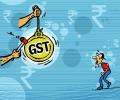
Over 100,000 small and medium-sized businesses are non-compliant with e-invoicing norms under the goods and services tax (GST) regime, a mandatory requirement for businesses with an annual turnover of over Rs 5 crore. E-invoicing provides real-time access to invoices that are prepared by the supplier on the purchase of goods, allowing faster accessibility to input tax credit, thereby limiting the manipulation of fake credit as it has to be generated before the transaction. "The default has been reported mainly in businesses with a turnover between Rs 5 crore and Rs 20 crore," a senior official informed

Taking both direct and indirect taxes, the gross collection is expected to grow 10.45 per cent to Rs 33.61 trillion in 2023-2024.

The situation raises concerns about whether the promised freebies will once again push the state into a revenue deficit.

The Centre could further moderate its divestment target for 2024-25 (FY25), as it does not expect large receipts from asset sales - except some ongoing strategic ones, including IDBI Bank, which could spill over into next financial year. Also, it may drastically reduce its FY24 divestment target of Rs 51,000 crore. "We are still evaluating the Budget estimates for FY25. "New big-ticket asset sales are unlikely.

As political winds stir in these states, it's prudent to assess their economic landscapes.

'This year's detection of frauds and probable recovery will be mainly driven by several compliance measures put in place, and amendments made to the GST regime to plug revenue leakages particularly in new-edge sectors.'

Per capita income in the state has consistently been below the national average for at least 24 years. However, it has narrowed the gap with the all-India level in recent years.

Despite high headline numbers, the output of one-third of the segments in the manufacturing sector in August stood below even that in the same month in 2011-12, when the new index of industrial production (IIP) series started. This is despite the fact that manufacturing grew 9.3 per cent in the month, driving up IIP growth to a 14-month high of 10.3 per cent. Part of it is due to the devastation of these product categories by lockdowns induced by Covid waves and subdued export conditions, while part of it needs to be assessed further.

The Union government's finances witnessed significant improvement in August after a stressful first four months of the current fiscal year. India's gross tax revenue, comprising both direct and indirect taxes, for the first five months of 2023-24 surged 16.5 per cent year-on-year (Y-o-Y) to Rs 11.8 trillion. During the April-July period, gross tax revenue increased by a mere 2.8 per cent compared to the Budget Estimate of 12.1 per cent growth for FY24.

Union excise duty collection dropped 18 per cent in August year-on-year at a time when the overall central tax kitty rose about 94 per cent before devolution to the states. The mop-up from Union excise duty declined to Rs 23,576 crore in August this year compared to Rs 28,816 crore in the same month a year ago. On the other hand, total tax collection rose to Rs 2.9 trillion in the month as against Rs 1.5 trillion in August 2022-23, shows the data released by the Controller General of Accounts (CGA).

The Union government's revenue from securities transaction tax (STT) is on track to exceed its Budget projection for the current fiscal year, with the mop-up already surpassing 50 per cent of the annual estimate. Provisional figures reveal that the Centre has collected approximately Rs 14,000 crore in the first half of this fiscal year up to September, according to a government official. This amount exceeds half of the full-year target of Rs 27,625 crore set for FY24.

'Inter-ministerial coordination, information on the proposed PSUs, and due diligence are taking longer than expected to conclude the process.'

Populism gains momentum during election periods, and this trend is evident in at least four states: Telangana, Rajasthan, Madhya Pradesh and Chhattisgarh.

'I want us not to underestimate Indian voters. They can tell good work from bad.'

'There are occasions when the prices of individual items like food raise inflation; then supply-side measures must be taken.' 'But if there is continued inflation, it means liquidity is aggravating the situation.'

Life Insurance Corporation (LIC) may require at least five more years to comply with the minimum public shareholding of 25 per cent beyond the current exempted timeline of 2027. Formal communication in this regard had been shared recently with the finance ministry, underlining LIC's roadmap, plans of further dilution of stake, current norms around public float, and challenges ahead, a government source familiar with the matter said. "Going forward, we will have to take a call, along with Sebi (Securities and Exchange Board of India) and the Department of Economic Affairs on the roadmap for minimum public shareholding (MPS).

Almost all verification and assessments of returns selected for scrutiny are being done electronically through an anonymous back office, manned by tax experts and officials, without any personal interface between taxpayers and officers.
India's gross tax revenue, comprising both direct and indirect taxes between April and July, reported a growth rate of merely 2.8 per cent to Rs 8.9 trillion compared to the same period a year ago, as shown by government data on Thursday. This growth was dampened by direct tax figures, offsetting the healthy growth in goods and services tax collections and Customs duties. While net tax revenue contracted by 12.6 per cent to Rs 5.8 trillion up to July, accounting for 25 per cent of the Rs 23.3 trillion full-year target, this could be attributed to the increased tax devolution to states during the period.

'Most young taxpayers prefer income tax filing to be flexible yet straightforward.'

'We are engaging in substantial open market sales of both wheat and rice to control food inflation; special measures of market intervention in vegetables, pulses and oil seeds were also taken to cushion the impact.'
 © 2025 Rediff.com - Investor Information - Advertise with us - Disclaimer - Privacy Policy - Sitemap - Feedback - About us - Terms of use - Grievances